
Encrypted two-way radio
IEEE 802.15.4, robust against interference and approved worldwide. Remote and boat exchange data constantly — not just commands.
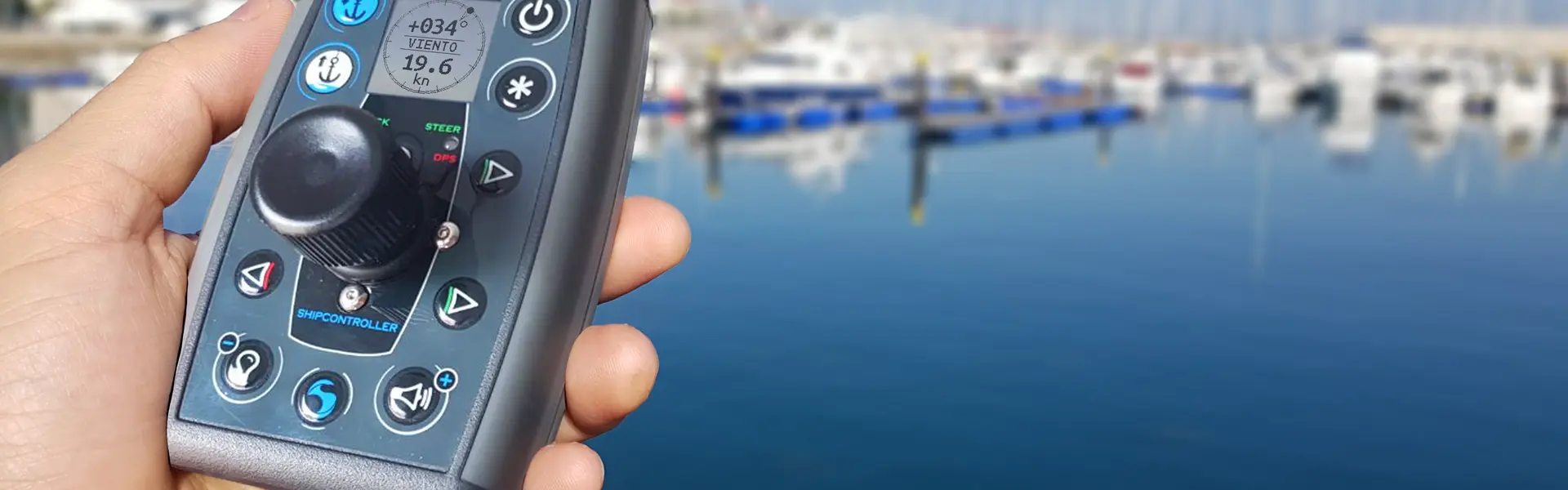
Wireless docking control for motor yachts
The last ten metres decide the day. Shipcontroller puts engines, thrusters and windlass in your hand — so you stand where you see the gap, the fender and the line, and bring her in calmly. Even short-handed. Even in a crosswind.
01 — The last ten metres
Docking a motor yacht is rarely hard because of the boat. It is hard because of what you can’t see, can’t hear and can’t reach from the helm. These are the moments Shipcontroller was built for.
You can’t see the stern from the helm.
From the flybridge or the upper helm, the quay, the swim platform and your neighbour’s bow are all in the blind spot.
Take the helm with you. Walk to the stern, the quarter or the side deck and steer from where you see the gap.
Your crew is on the bow with a line — and can’t hear you.
Shouting over engines and wind, hand signals that mean something different at each end of the boat.
Be where the line is. Go forward yourself, judge the distance with your own eyes and correct with a touch of thruster.
The wind pushes the bow off the moment you slow down.
Two throttles, two gear levers and a thruster — all at once, while the gap closes.
One joystick. Push it toward the quay; engines and thrusters are combined for you to move her sideways.
Fenders and lines aren’t ready — and you’re already inside the harbour.
Circling in a crowded fairway, or drifting toward the boats next door while you run around the deck.
Let the boat wait. Position and heading are held automatically while you prepare in peace.
Stern-to, anchor down, reversing into a narrow slot.
The windlass is at the bow, the helm is amidships, and the gap is at the stern.
Anchor and engines in one hand. Drop the anchor, watch chain length and depth on the display, keep her straight.
The lines are on — but she drifts off before they’re tight.
One person on the cleat, nobody at the helm.
Hold mode. One button runs both thrusters gently toward the quay while you make fast.
02 — A docking, step by step
How a typical docking looks with an EZVector remote and Shipcontroller DPS — from the harbour entrance to the last line.
Stop in the fairway. The boat holds position and heading while you set fenders and lay out lines — no circling, no drifting.
Walk to the stern with the remote. Speed and depth are on its display; a vibration warns you if the water gets shallow.
Turn the yacht on the spot until the stern points into the berth. No forward way, no guesswork.
Astern or sideways in small, controlled movements. When a gust arrives, a double press gives the thruster its second power level.
Both thrusters press her gently against the quay while you secure the lines. Then put the remote back on its wireless charger.
Available functions depend on the remote and the boat’s propulsion. DPS is an optional module for EZVector and DockerPro.
03 — Smart manoeuvres
Moving a twin-engine yacht sideways normally takes two throttles, two gear levers and a thruster, all at once. The EZVector algorithms translate one joystick movement into the right combination of engines and thrusters.
Port engine astern, starboard engine ahead, bow thruster to starboard. The yacht walks sideways toward the quay.
Press once for one power level, press twice and hold for another — 60% and 95% bow thrust, for example.
Short, precise thrust pulses, or a reduced average thrust from on/off thrusters and engines.
A dedicated control mode for Volvo IPS propulsion, alongside single and twin-engine configurations.
04 — Safety
That is where most of the engineering went. A remote that controls your engines has to know when it is in command — and tell you the instant it isn’t.
IEEE 802.15.4, robust against interference and approved worldwide. Remote and boat exchange data constantly — not just commands.
If the remote detects a loss of engine control, it warns you with vibration and light — in your hand, where you will notice it.
Several remotes on one boat, even of different models. Only one ever has control at a time.
Windlass and thrusters lock automatically above a set speed, so nothing can be triggered by accident underway.
Engines started from the remote require a deliberate two-step confirmation.
A graphical sounder trace and a configurable alarm, delivered as a vibration rather than a beep at the empty helm.
Protects windlass, rode and anchor from damage while raising and lowering.
Chain deployed, seabed depth and the ratio between them, live on the remote — the number that decides whether you sleep well at anchor.
On large yachts and metal decks, Shipcontroller NET adds bus-powered transceivers for range and redundancy.
05 — The remotes
All three bring the helm to where you dock. They share the same radio, build quality and safety logic — and differ in how you like to steer, and how much the remote tells you back.
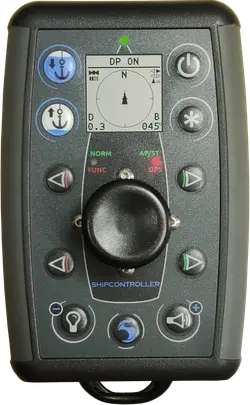
Joystick · The easiest docking
A three-axis Hall-effect joystick and the full Shipcontroller feature set. Combined manoeuvres such as sideways movement and controlled rotation are a single gesture.
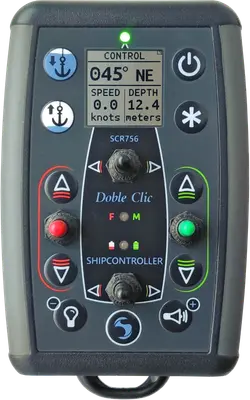
Levers · Display & DPS
Direct toggle levers for engines and thrusters, combined with the graphical display, telemetry and the multifunction modes of the EZVector.
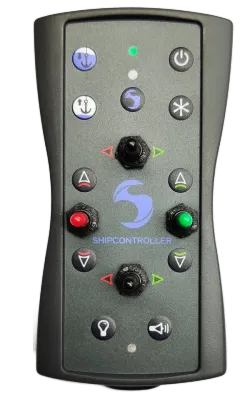
Levers · The essentials
Everything needed to dock and anchor, nothing more. Also the ideal backup remote alongside an EZVector or DockerPro, with concurrency control built in.
| EZVector | DockerPro | DockerOne | |
|---|---|---|---|
| Encrypted bidirectional radio | ● | ● | ● |
| Wireless Qi charging, LiPo battery | ● | ● | ● |
| Vibration alerts | ● | ● | ● |
| Mechanical buttons, no membrane | ● | ● | ● |
| Windlass, horn and deck lights | ● | ● | ● |
| Sunlight-readable display | ● | ● | — |
| Navigation data telemetry | ● | ● | — |
| Chain counter & scope calculator | ● | ● | — |
| Graphical sounder & depth alarm | ● | ● | — |
| Hold mode, Autopilot mode, DPS mode | ● | ● | — |
| DobleClic, PulseThrust | ● | ● | — |
| Continuous proportional control | ● | Stepped | — |
| SwayEase, PivotPoint, ThrustersBalance | ● | — | — |
| Volvo IPS mode | ● | — | — |
06 — Dynamic positioning
Launched in 2021, Shipcontroller DPS was the first affordable, general-purpose dynamic positioning system for leisure boats. It holds position and heading within tight margins — and when you touch the remote, you are in command again. Release it, and DPS takes over from the new position.
DPS is one of the remote’s operating modes. Propulsion control remains fully available.
Calculates position and heading error and commands engines and thrusters. Monitors itself and alarms on any critical fault.
Hemisphere GNSS® V200n receiver and satellite compass, dedicated exclusively to DPS. NMEA 2000 bridge available.
07 — The display
A hybrid-technology graphical display with ultra-low power draw and a high refresh rate. It stays legible in direct sunlight and at dusk, and it is where every setting of the system lives — no laptop needed on board.
08 — Compatibility
A remote is only as good as the systems it can reach. Shipcontroller interfaces with the propulsion, thrusters, windlasses and data networks of most modern motor yachts — and develops new interfaces for older control systems, extending their working life.
09 — The system
Every installation starts from the same CANbus backbone. Add what the boat needs, when it needs it.
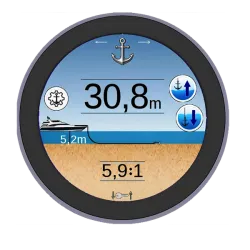
A round 3″ multifunction touch display for the helm: DPS control, anchoring, alarms and depth alerts in one instrument.
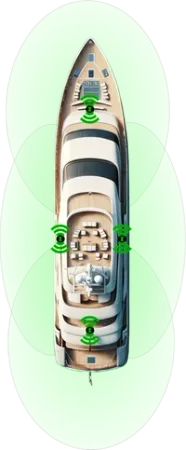
Multiple bus-powered transceivers form a redundant mesh across large vessels and metal decks. CANbus runs of 250 m and more.
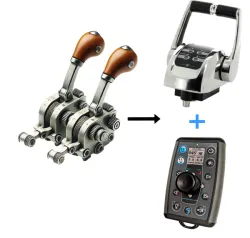
Electronic engine control for boats that were built without it — the first step to wireless command.
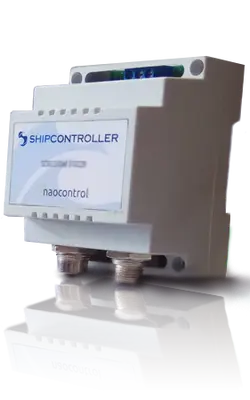
Tailored hardware and software for unusual configurations, gangways, platforms and specialist vessels.
10 — Naocontrol
We design and manufacture the entire system ourselves — the hardware, the embedded software and the applications behind it.
Remotes, transceivers, positioning and interface units, engineered and assembled in-house.
Control algorithms, radio protocol and safety logic written by the same team that designs the boards.
Windows tools for installers and owners, plus OnRemoteSetup, which puts nearly every setting on the remote itself.
Shipcontroller is a product of Naocontrol, member of the National Marine Electronics Association.
11 — Contact
Every Shipcontroller is configured for a specific vessel. The more we know about yours, the more precise our proposal will be.
Prefer a local installer? Find a distributor